
Madison County Directory Collections
Verified local directories start before the Civil War and continue into the early twenty-first century, though the surviving run is not continuous. The Huntsville History Collection provides a complete digital volume for 1896–97. The Alabama Department of Archives and History finding aid lists later Huntsville and Huntsville–Madison County editions. Local references also identify editions published in 1953 and 1957.
| Collection | Verified years | Where held | Access route |
|---|---|---|---|
| Directory, City Guide and Business Mirror | 1859–60 | Huntsville History Collection | Digital collection; 1972 reprint noted |
| Huntsville City Directory | 1896–97 | Huntsville History Collection | Complete free PDF |
| Huntsville editions | 1953 and 1957 | Historic Huntsville Quarterly citations | Confirm a copy with local collections |
| Huntsville runs | 1973–81, 1983–85, 1992–93, 1996, 2000–02 | Alabama Department of Archives and History, LPR104 | Finding aid and archive request |
| Huntsville–Madison County runs | 1998–99 through August 2006, selected editions | Alabama Department of Archives and History, LPR104 | Finding aid and archive request |
The state finding aid also renders a “1938–1984” label. It should not be read as proof of an unbroken yearly run without inspecting the underlying PDF. HMCPL has not posted a full shelf inventory or exact reverse-directory years, so a call or visit is the sound fallback for an edition missing online.
The free 1896–97 Huntsville volume can be previewed before a shelf visit.
The captured volume shows why a scanned original is more useful than a name-only transcription: street pages, advertisements, officials, and business entries give each resident context.
Madison County Directory Beginnings
The first verified local volume is the 1859–60 Huntsville Directory, City Guide and Business Mirror, published by Williams, or Coltart & Son. It places the local directory record just before the 1860 federal census. That pairing is valuable. The volume offers a name, trade, and local place phrase, while the census can add age, household ties, and birthplace.
Charles Alexander Gill’s entry records him as a carpenter who “beds at T. O. Gill’s,” at Holmes between Washington and Green. The wording is a warning against forcing a modern house number onto an early record. Madison County volumes from this era may describe lodging or use cross streets. The 1860 census, early deeds, and newspapers can test the identity.
| 1859–60 | First verified directory, best paired with the 1860 census |
|---|---|
| 1896–97 | Huntsville Directory Company volume, complete online |
| 1937 onward | Historic aerial coverage can add physical context |
| 1953 and 1957 | Postwar directory snapshots cited in local history sources |
| 2006 | Latest verified dated Huntsville–Madison County edition in the state finding aid |
Note: The verified dates form a layered timeline, not proof that a directory survives for every year between them.
Read Madison County Directory Entries
A directory entry compresses a life into a narrow line. George B. Gill appears in 1896–97 as a pension agent with an office in Halsey Block. Oscar Goldsmith’s 1908 entry links real estate work, an office on the north side of the Square, Dallas Manufacturing, and a home on Gates. Separate each place and role before drawing a conclusion.
| Personal name | The listed resident or worker; initials and spelling may shift between editions |
|---|---|
| Trade or role | An occupation, office, or firm affiliation that helps distinguish the same name |
| Residence clue | A numbered street, cross-street phrase, boarding place, or home notation |
| Business location | A separate shop, office, mill, or downtown address |
| Widow or spouse clue | A relationship note that can lead to death, marriage, and probate sources |
Black-letter names in the 1896–97 volume marked financial supporters. They did not identify household heads or social standing. The same book includes a publisher count of 11,400, street extents, occupations, advertisements, officials, and phone numbers, including an ad using “telephone 48, 4 rings.”
- Criss-cross directory
- A later address-first section arranged by street rather than surname. Exact Madison County shelf years remain unverified.
- Householder index
- A name or address list focused on the person tied to a home, not a full census of everyone there.
- Abbreviation key
- The volume’s own legend for short forms. Read it before interpreting work, residence, spouse, or boarding marks.
Madison County Directory Gaps
The 1896 publisher admitted that perfect accuracy was a “moral impossibility.” That old warning still matters. A missing person may have moved after canvassing, refused a listing, been recorded under initials, lived just beyond the covered area, or appeared through a spouse or firm. Absence from one Madison County directory edition is not proof of absence from the county.
Growth adds another problem. Huntsville expanded sharply during the 1950s as arsenal and rocket work drew newcomers. German surnames, initials in technical records, married-name changes, and routes through mill villages or new suburbs can break a straight surname search. Compare the editions on both sides of a gap, then test the name in census, deed, newspaper, and obituary sources.
Search tip. Record every spelling, initial, employer, and address clue before deciding that two directory entries describe different people.
Madison County Directory Research Room
Huntsville-Madison County Public Library Special Collections is the main local stop when an online volume search fails. Its holdings combine local-history books, microfilm, maps, photographs, diaries, letters, scrapbooks, group records, newspapers, and the Zeitler Rare Book Collection. The archival program began in 1976, and a Heritage Room opened in the 1986 building before later merging with archives.
Special Collections is at 915 Monroe Street SW in Huntsville. The research contact is 256-532-5969 and hhrdept@hmcpl.org. Confirm current hours before going. Staff policy says city-directory information is not supplied by telephone, so plan for in-person research. A call still helps verify that an edition or format is available.
The HMCPL local-history guide previews the range of sources that can be paired with directory entries.

The guide points beyond bound volumes to newspaper databases, AlabamaMosaic, family-history tools, and local digital collections, which can fill a missing edition.
Note: Bring names, approximate years, and all known street forms so staff can direct the search to the right shelf or microfilm.
Madison County Directory Archive Paths
No single repository holds the whole local story. HMCPL manages community history, newspapers, and local volume access. The Alabama Department of Archives and History supplies the later directory finding aid. UAH Archives, Special Collections, and Digital Initiatives adds Tennessee Valley, political, aerospace, and family manuscript records that can identify a person found in a mid-century edition.
UAH’s catalog can be narrowed by search terms, operator, record type, field, and year range. More than 221 described collections include oral histories of rocket pioneers, German scientists, Saturn V staff, Redstone workers, and other community members. The Frances Cabaniss Roberts papers also span family letters, houses, churches, groups, legal records, cemeteries, and Madison County history. Access is available at 301 Sparkman Drive NW, library lower level, weekdays 9 to 4, with appointments and digitization requests available.
The UAH archival catalog is a strong follow-up when a printed directory lists a technical firm or community institution.
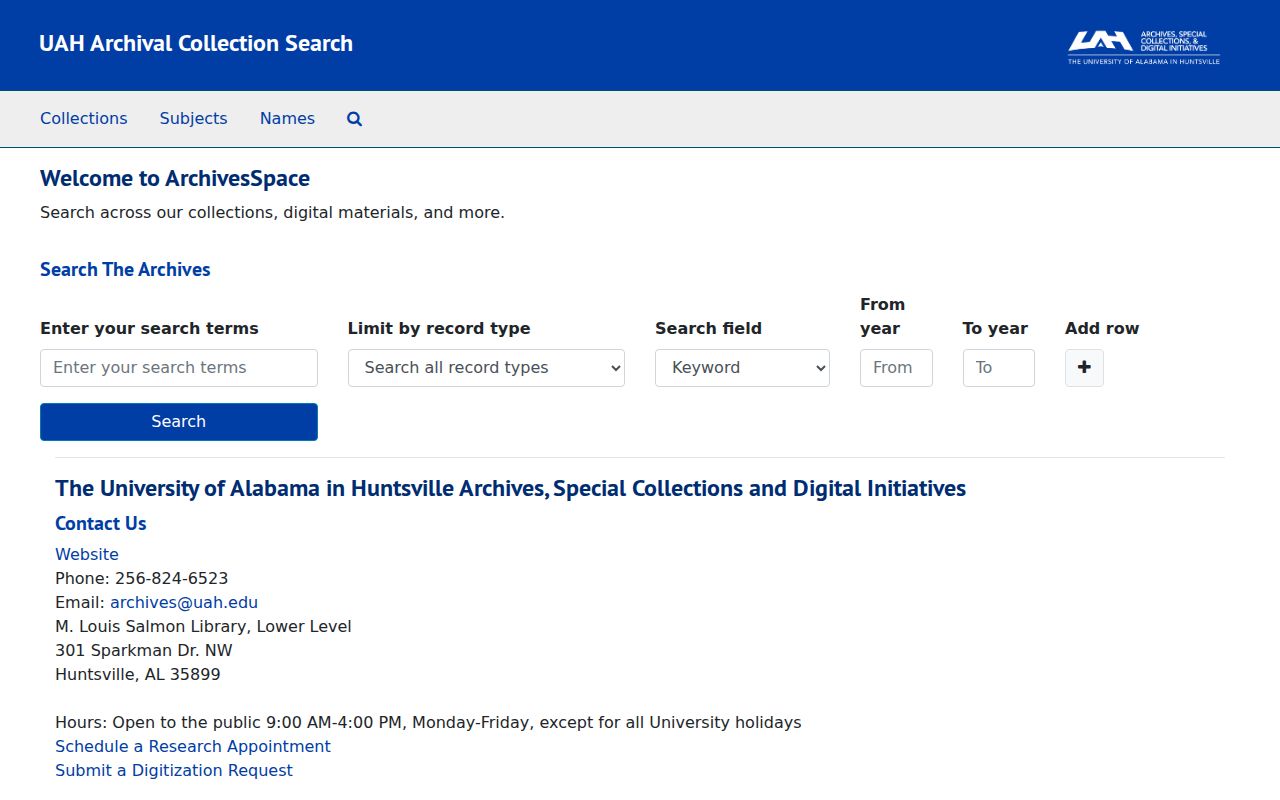
Its structured search makes a year and name more useful than a broad web query, especially for the postwar aerospace era.
Madison County Directory by Address
Exact reverse or criss-cross runs are not published in the library’s online shelf list. The Huntsville History Collection’s Find Place feature is the best verified address-first substitute. It covers Downtown, Twickenham, Old Town, Five Points, mill villages, Madison Station, an 1871 view, 1950s aerials, and clickable historic addresses.
Use that place layer when an old entry says “between” two streets or when a house number changed. It can establish the district and physical setting, but it does not replace a directory entry or prove who lived inside. Modern street-level work belongs in the Madison County street directory, while historical volumes remain the source for dated name-to-place evidence.
Trace Madison County Directory Families
A good family-history trail uses each directory as a dated clue. It does not treat a run of listings as a full life story. Write down the exact edition, page, spelling, work, residence, and any spouse or widow notation. Then compare both the name pages and street guide.
- Find the earliest likely listing and save the full entry, not just the surname.
- Read adjacent editions for a move, new occupation, widow notation, arrival, or disappearance.
- Pair 1859–60 with the 1860 census and 1896–97 with the 1900 census, deeds, and newspapers.
- Pair mid-century editions with the 1940 or 1950 census, historic aerials, and Sanborn maps where available.
- Close the trail with an obituary, cemetery record, probate case, or archival manuscript.
A printed directory records one publishing moment. A census records a household on its census date. Deeds identify title transfers, not necessarily occupants. Agreement among these sources is much stronger than any one item alone.
Madison County Directory Endpoints
The HMCPL Obituary Index is a practical endpoint when a resident disappears from later editions. It searches a deceased person, cemetery, or newspaper. Results can include prefix, first, middle, maiden, and last names, publication date, and interment place. The index reports 68,281 references from the Huntsville Times, plus thousands from predecessor papers, while photocopies cost $5.
The Huntsville obituary index can test whether a directory disappearance reflects death rather than a move.
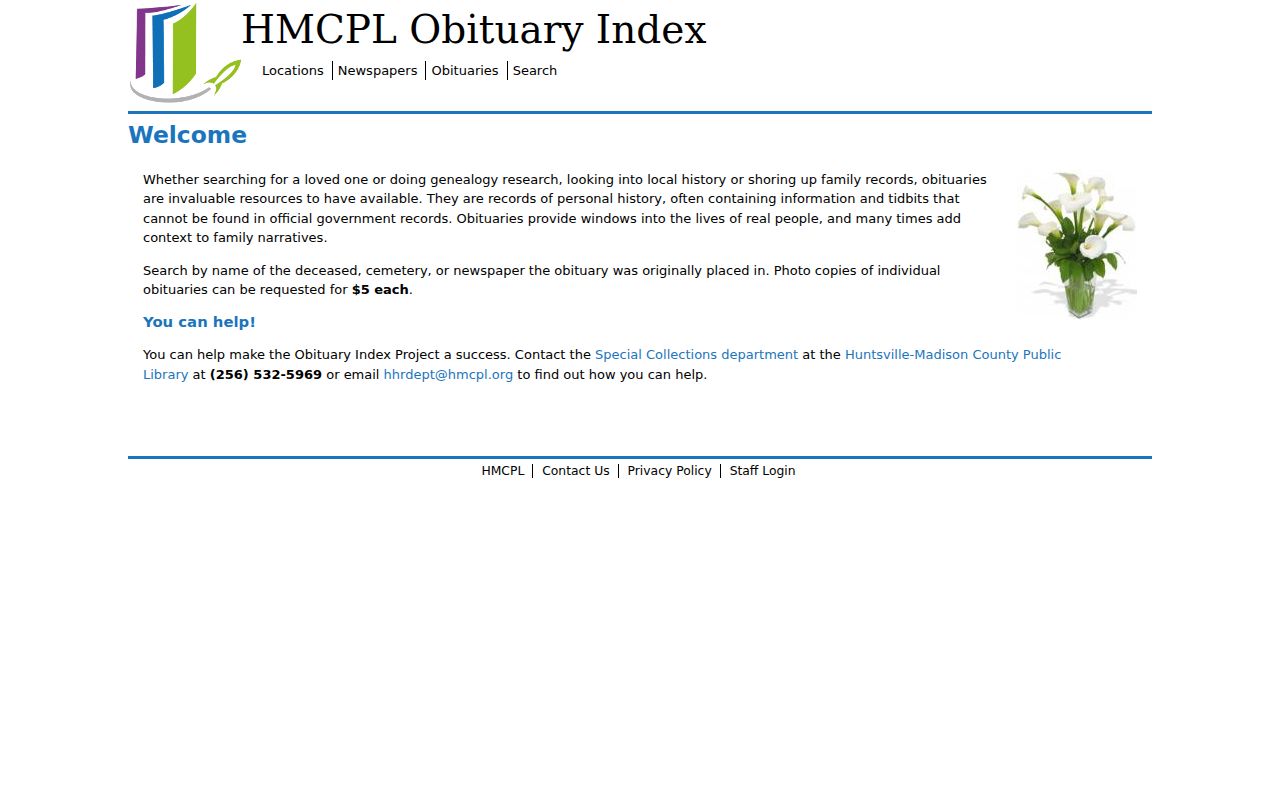
The search screen adds cemetery and newspaper routes, useful when a surname has changed or a publication is the only known clue.
If no obituary appears, check predecessor newspaper spellings and ask Special Collections about coverage. Probate estates and cemetery records are separate custodial sources. They can confirm kin or death, but a blank index result cannot prove that no notice was printed.